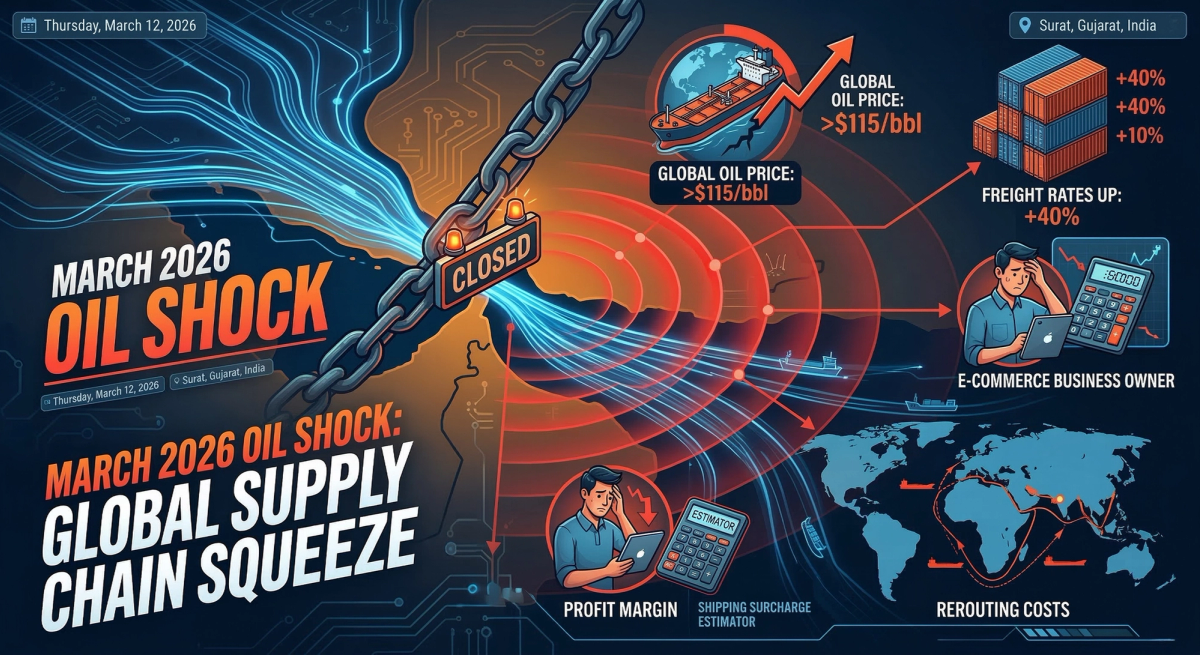
Following the military escalations on February 28, 2026, the Strait of Hormuz—the world's most critical maritime chokepoint—was effectively brought to a standstill. With major carriers suspending transits and rerouting vessels, the ripple effects are already hitting energy markets, freight rates, and ultimately, the profit margins of independent businesses.
Here is the factual breakdown of what is happening right now in March 2026, and how you need to adjust your financial forecasting.
🚢 1. The Immediate Freight and Shipping Reality
The closure of the Strait of Hormuz has choked off roughly 20% of the world's daily oil supply and 20% of global LNG. This has triggered an immediate spike in operational costs for major shipping lines.
- Massive Container Surcharges: To deal with the crisis, major carriers have immediately implemented emergency fees. For example, CMA CGM has introduced an Emergency Conflict Surcharge (ECS) of up to $4,000 per container on specific trade lanes. Hapag-Lloyd has implemented a War Risk Surcharge (WRS) of $1,500 per standard TEU.
- Extended Transit Times: Shippers like Maersk and MSC are being forced to reroute vessels around the Cape of Good Hope. This detour adds roughly 10 to 14 days to transit times between Asia and Europe or the Americas, tying up capital in inventory for an extra two weeks.
- Fuel Cost Spikes: With Brent crude pushing past $90 a barrel in early March and marine bunker fuel prices surging nearly 100% for low-sulphur options, the base cost of moving goods has skyrocketed.
📦 2. The Direct Hit to Amazon FBA & E-Commerce Sellers
For independent brands, these macro-economic shifts trickle down to daily operations very quickly. The impact is hitting businesses in three distinct waves:
- Inbound Freight Spikes: Getting inventory from overseas manufacturers to local warehouses now carries massive, unavoidable surcharges.
- Compounding Platform Fees: This supply chain shock arrives exactly as major platforms adjust their own logistics. For instance, Amazon's recent 2026 increases to inbound placement service fees mean sellers are paying more to distribute inventory, just as it becomes more expensive to import it.
- Cash Flow Crunches: With inventory spending an extra two weeks on the water, your cash conversion cycle is extended. You are paying for goods earlier and selling them later.
🛡️ How to Defend Your Business Margins Today
Survival during a supply chain shock comes down to hyper-accurate financial forecasting. You can no longer rely on last quarter's shipping estimates.
- Audit Your True Landed Costs: You must factor in the new $1,500+ container surcharges to calculate your exact landed cost per unit today.
- Optimize Pricing: If your logistics costs have increased by 15%, absorbing that cost might wipe out your net profit. You need to adjust your retail pricing strategically to share the burden without killing conversion rates.
- Run the Numbers: Don't guess. Use dedicated financial tools to run different "worst-case" scenarios on your profitability.
Artículos Relacionados
 Finance
Understanding the Impact of Oil Prices on the Global Economy
Oil prices significantly affect the global economy.
 Crypto
Web3 Expansion and Loyalty Programs in Crypto
Exploring Web3 expansion and loyalty programs.
 Tutorials
Mastering Oracle APEX: A Step-by-Step Guide
Learn Oracle APEX with our comprehensive guide.